panama-business
How a professional firm can route new inquiries cleanly
A clear process for new inquiries keeps intake, qualification, and follow-up visible. Here is a model for professional service firms.
May 23, 2026 · 7 min read · Jeffery Gyamerah
A new inquiry arrives from your website. An assistant sees it, forwards it to a partner, but the partner is in meetings all day. The email gets buried. Another inquiry comes via a direct referral to a senior associate who is about to go on vacation. It sits in their inbox, unanswered.
Every professional services firm experiences this: the chaotic, manual, and often unreliable process of handling new business opportunities. This isn't a personnel problem; it's a process problem. Without a clear, systematic way to receive, qualify, and route new inquiries, potential clients are lost to delays, miscommunication, or simple forgetfulness.
Establishing a clean workflow is the first step toward strategic growth and operational control.
First, centralize the entry points
Before you can manage inquiries effectively, you need to know where they all are. Most firms have multiple "front doors": potential clients might use a website contact form, send an email to a general info@ address, call the main line, or be referred directly to an individual professional.
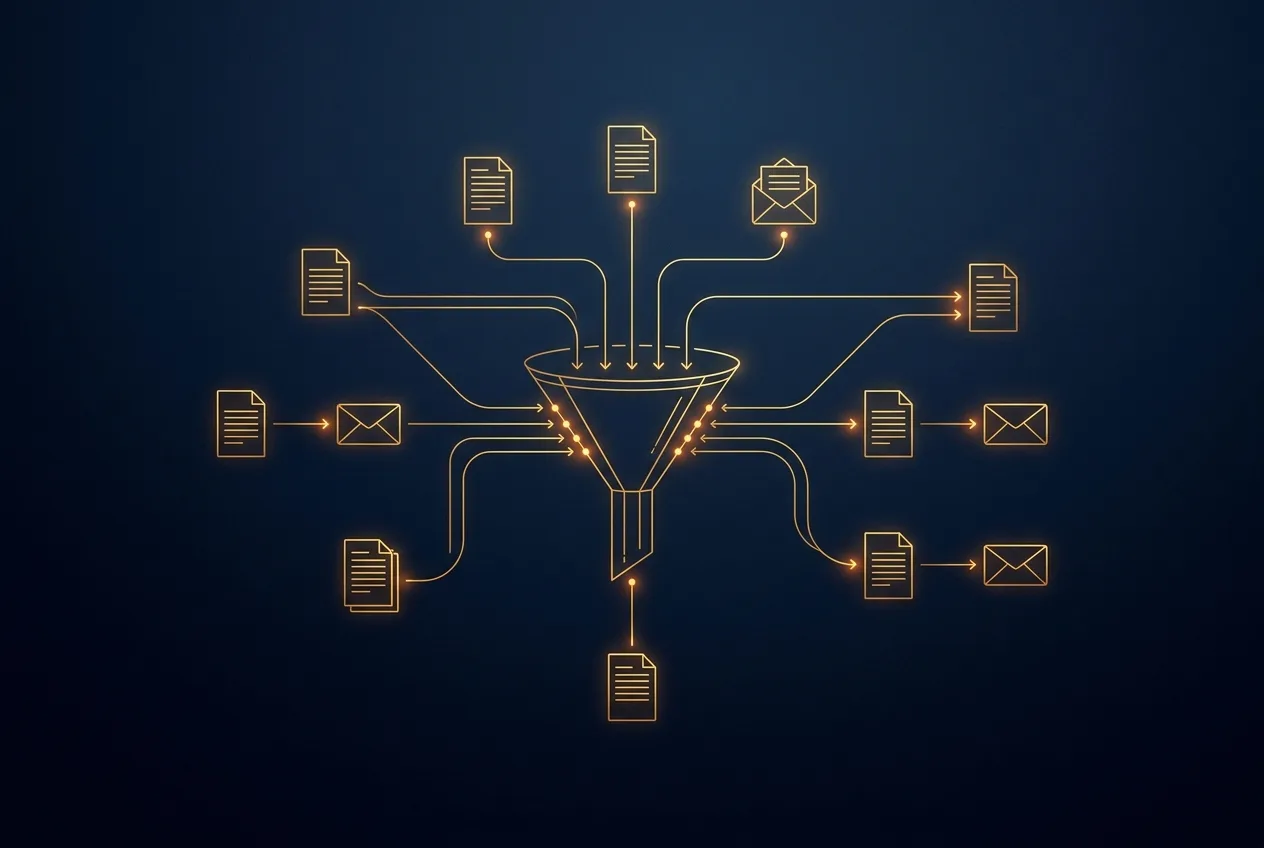
When each entry point is managed by a different person or in a different way, chaos is inevitable. The first operational decision is to funnel all new inquiries, regardless of origin, into a single, monitored location. This could be a dedicated email inbox, a channel in a team messaging app, or a simple spreadsheet.
Imagine a mid-sized accounting firm in Panama. Inquiries come from their website, direct emails to three partners, and calls to the receptionist. The partners are busy and often forget to log the inquiry, and the receptionist writes notes that sometimes get lost.
The solution starts not with buying expensive software, but with a simple rule: all new business inquiries, no matter how they arrive, must be logged in one central place immediately. If a partner gets a direct email, they forward it to the central inbox. If the receptionist takes a call, they fill out a digital form that feeds the central log.
This act of consolidation is the foundation. It transforms a scattered set of events into a single, manageable queue.
Second, define the path forward
Once all inquiries land in one place, the next question is: what happens now? This is where qualification and routing come in. Not every inquiry is a good fit, and not every team member is the right person to handle every type of request.
Defining the path forward means creating simple, clear rules for what to do with an inquiry based on the information provided. Qualification is the process of asking the initial questions needed to understand the potential client's needs. A basic checklist should answer:
- Is their budget aligned with your fees?
- Do they need a service you actually provide?
- Is the timeline realistic?
This doesn't have to be an interrogation; it can be a simple checklist that an administrator or junior team member can run through.
A routing system isn't about complex software; it's the operational expression of your firm's expertise and capacity. It answers: 'Based on what we know, who is best equipped to handle this right now?'
Routing is the logical next step. Based on the qualification checklist, the inquiry is assigned to the correct person or team. For example:
- Corporate tax structuring above a certain budget → Partner A.
- Smaller individual tax question → Associate B.
- Request for a service you don't offer → polite, templated response.
These rules translate your firm's internal logic into a repeatable process. They ensure the most valuable inquiries get to your most skilled people quickly, while lower-priority items are handled efficiently without distracting senior staff.
Can you write down, in three sentences, who should handle a new inquiry for your most profitable service? If not, that's your starting point.
Third, create visibility and accountability
A central queue and clear rules are a major improvement, but the system is incomplete without visibility. A process that lives only in one person's inbox is a process waiting to fail. The final step is to make the status of every inquiry visible to the people who need to know.
The goal is to eliminate the "black hole" where a potential client sends a message and hears nothing back. A system, even a simple one, provides this shared view.
It could be a project management board where each inquiry is a card that moves from "New" to "Assigned" to "Contacted" to "Closed." Or it could be a customer relationship management (CRM) tool that logs every interaction.
The specific tool is less important than its function: to create a single source of truth about the status of every inquiry.
When the managing partner wants to see the new business pipeline, they can look at the dashboard. When an associate is assigned a new lead, they get an automatic notification. The system can also enforce accountability through automatic reminders and follow-ups:
- Any inquiry in the "New" column for more than four business hours triggers an alert.
- The assigned person receives an automatic task to follow up in three days if no response is received.
This is how you translate good intentions—"we should respond to people quickly"—into a reliable operational reality. It ensures a consistent, professional experience for every potential client, every time.
Work with AdwenTech
Designing and implementing a clean inquiry management system turns operational friction into a competitive advantage. At AdwenTech, we help professional service firms translate their business logic into streamlined, automated workflows. If you are ready to build a system that ensures no opportunity is missed, contact us to discuss how we can help. See our approach to Process Automation for more details.