AI Basics
The difference between a chatbot and a workflow
A chatbot talks; a workflow moves work through clear steps, owners, checks, and outcomes.
May 9, 2026 · 7 min read · Jeffery Gyamerah
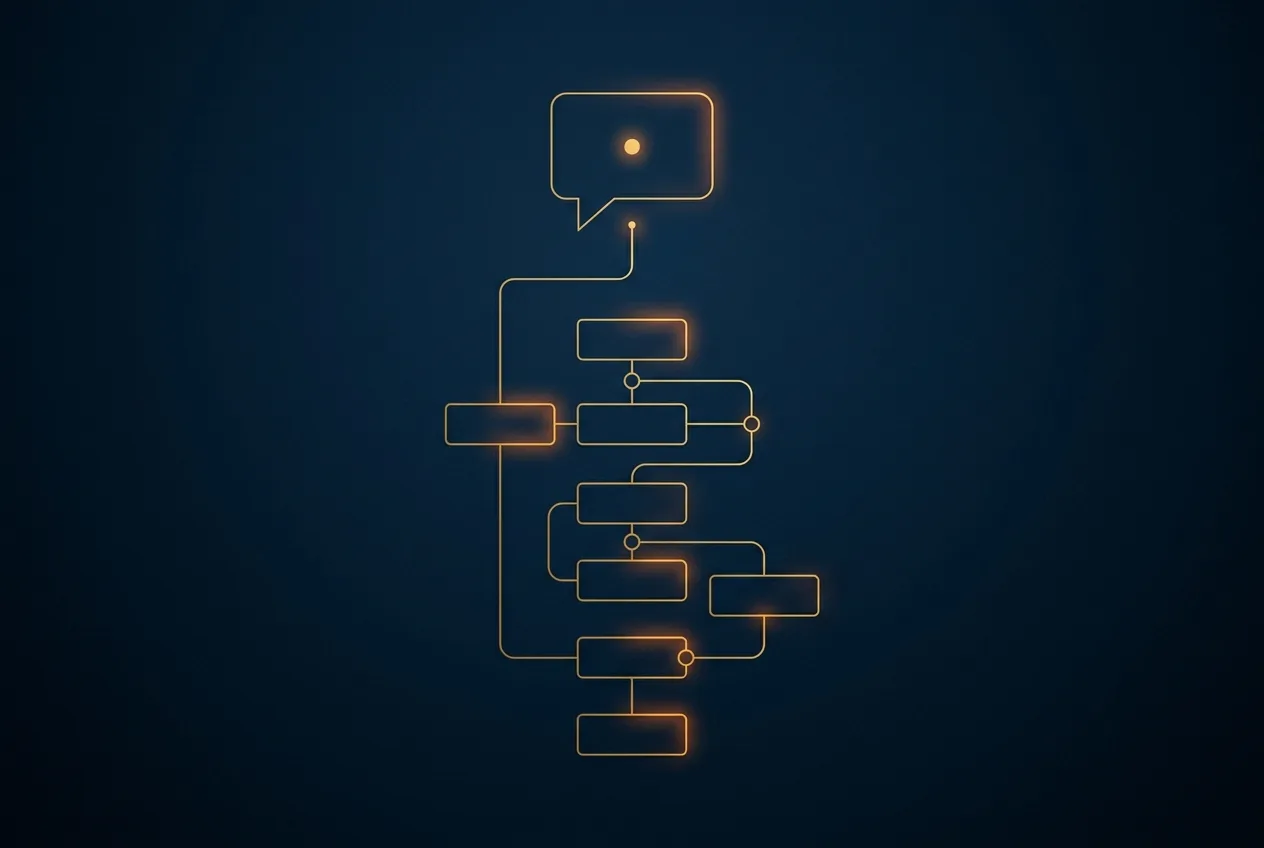
In the conversation about business automation, the terms 'chatbot' and 'workflow' are often used interchangeably. This creates confusion, leading business owners to invest in tools that don't solve their core problem.
A chatbot is designed for conversation, while a workflow is designed for process. Understanding this distinction is the first step toward building an operational system that saves time, reduces errors, and allows your team to focus on valuable work.
Chatbots manage conversations
The primary function of a chatbot is to simulate human conversation. It is an interface, a tool that sits between your business and a user—be it a customer, a potential client, or even an internal team member.
Think of the chat windows that pop up on websites, automated responders on social media, or interactive voice menus on a phone line. Their job is to understand a user's intent from their words and provide a relevant, often scripted, response.
Common applications are front-line and repetitive:
- Frequently asked questions: "What are your business hours?" or "Do you offer shipping to my area?"
- Initial lead qualification: asking simple questions like "Are you looking for residential or commercial services?"
- Basic scheduling: guiding a user through booking an appointment without human intervention
They are built to manage a high volume of predictable interactions, freeing up human agents for more complex or nuanced conversations.
A helpful analogy is to think of a chatbot as a receptionist in your lobby. They can greet visitors, answer common questions, point them to the right department, and take a simple message.
However, the receptionist does not do the core work of the business—they don't prepare the legal brief, design the building, or analyze the financial reports. A chatbot can collect information that triggers a process, but it is not the process itself.
Workflows move work
Where a chatbot manages conversation, a workflow executes a process. A workflow is a structured sequence of tasks, handoffs, and decisions designed to achieve a specific business outcome.
It is the digital backbone of an operational procedure, moving a piece of work from 'not started' to 'complete' through a predefined path. It is not primarily conversational; it is procedural and action-oriented.
If a chatbot is the receptionist, a workflow is the assembly line or the project plan. It dictates what happens, in what order, who is responsible for each step, and what criteria must be met to advance.
Examples are everywhere in service businesses:
- The multi-step process for onboarding a new client
- The system for approving a creative proof
- The procedure for processing an insurance claim
- The quality assurance checklist for a completed project
These are not conversations; they are structured operations.
A chatbot is a single actor in a play; a workflow is the entire script, directing all actors and scene changes from start to finish.
A well-designed workflow contains several key elements that ensure work is done consistently and correctly, regardless of who is performing the task.
Components of a robust workflow
An effective automated workflow is more than just a to-do list. It includes:
- Triggers that initiate the process
- Actions performed by people or systems
- Conditional logic that directs the flow
- Clear ownership for each step
- A defined final outcome
For example, a client signing a contract (the trigger) could automatically create a project in your management software (action), assign a project manager (ownership), and send a welcome packet (another action), all without manual intervention.
Chatbot and workflow: better together
The distinction between these tools is not meant to position one as better than the other. In fact, the most effective operational systems often use them in concert.
A chatbot can serve as the conversational 'front door' to a powerful workflow that acts as the operational 'engine' in the background. They are not competitors for your budget; they are collaborators in a single, cohesive system.
Imagine a potential client visiting a law firm's website after hours. The chatbot initiates a conversation, asking key qualifying questions: their name, contact information, the type of legal service they need, and the urgency of their matter.
Once the chatbot has collected this information, it doesn't just send an email to a general inbox. Instead, it triggers a sophisticated 'New Client Intake' workflow. The workflow automatically creates a contact in the firm's CRM, assigns a paralegal to review the case details within 24 hours, runs an automated conflict check against a database, and based on the outcome, either sends the client a link to schedule a consultation or a polite message explaining that the firm cannot take their case.
The chatbot handled the conversation; the workflow executed the complex business process.
Ask yourself: "Do I need to talk to a user, or do I need to get a job done?" If your primary goal is interaction and information gathering, start with a chatbot. If your goal is to execute a multi-step process, start with a workflow.
By combining a conversational interface with a procedural engine, you create a system that is both user-friendly on the outside and operationally efficient on the inside. The customer gets an immediate, helpful response, and your business gets a structured, automated process that reduces manual data entry, prevents leads from falling through the cracks, and ensures every new inquiry is handled consistently and professionally.
Work with AdwenTech
Understanding the right tool for the job is central to effective automation. At AdwenTech, we focus on designing the underlying process first, ensuring that any technology we implement is built on a solid operational foundation.
We help service businesses map their critical workflows and then build the right automations—whether that involves a chatbot, a complex backend workflow, or both. To build a more resilient and efficient operation, contact us to discuss your process or learn more about our operations design services.